




Virtual Instructor
The "virtual instructor" has two main functions:
- Submit orders to be executed by the student while driving;
- Warn the drivers of violations.
For proper learning, the student must fulfill the orders and instructions given by the "virtual instructor" along the exercises of each of the modules. In case of error or failure to perform, the "virtual instructor" will send a message, as appropriate.
The simulator?s ?virtual instructor? eliminates the need for the physical presence of an instructor, although we counsel the use of an instructor in person who is always an asset in driving instruction for the student.
Objectives
At the beginning of each exercise the virtual instructor presents the objectives to be achieved by the student, so that the student realizes what must be done to successfully complete the module.
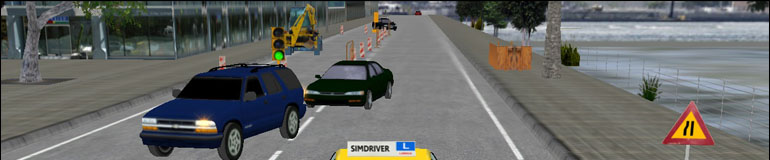
In the initial image is an example of one of those objectives presented at the beginning of the exercise.
Final driving report
At the end of each exercise, as long as the initial goals proposed by the instructor are reached, a brief report will be displayed with the time and distance travelled during the exercise.
It will also display the feedback of total of positive actions ? and negative actions, which are grouped in different levels:
- Driving mistakes;
- Infractions, minor infractions, severe and very severe.
The initial image on the left illustrates a final report of a module.
Major errors the virtual instructor detects
| - Lack of safety belt; - Wrong side driving; - Wrong way driving; - Failing to stop at a stop sign; - Deviating from the circuit path; - Failing to use turn signals; - Crossing continuous road lines; - Crossing a yellow traffic light; - Crossing a red traffic light; - Colliding with pedestrians and/or vehicles; - Colling with rails or sidewalks; - Ignore priorities in passages; - Ignore another vehicles? priority; - Reduced speed on the highway; - Stopping on the highway; - Select reverse on a highway; - Not switching headlights on at night; - Not using windscreen wipers during -Rain circuits; - Change gear when rotation is low; - Safety distance; | - Changing gear when rotation is high; - Changing direction using the wrong turn signal; - Allowing the vehicle engine off; - Motor off with handbrake engaged; - Select non-sequential gear; - Accelerating and braking simultaneously; - Excessive speed; - Hitting the clutch while in motion; - Stepping on the side of the road; - Reversing while in motion; - Not switching on the lights in tunnels; - Not turning off the lights; - Ignoring crosswalks; - Driving in Bus lane; - Stopping at Yellow Box; - Speeding; - Undue use of high beam headlights; - Lights off during fog circuits; - Not using clutch when shifting gear; - Etc. |